
Decision Making: When to Prioritize Technical SEO over Content
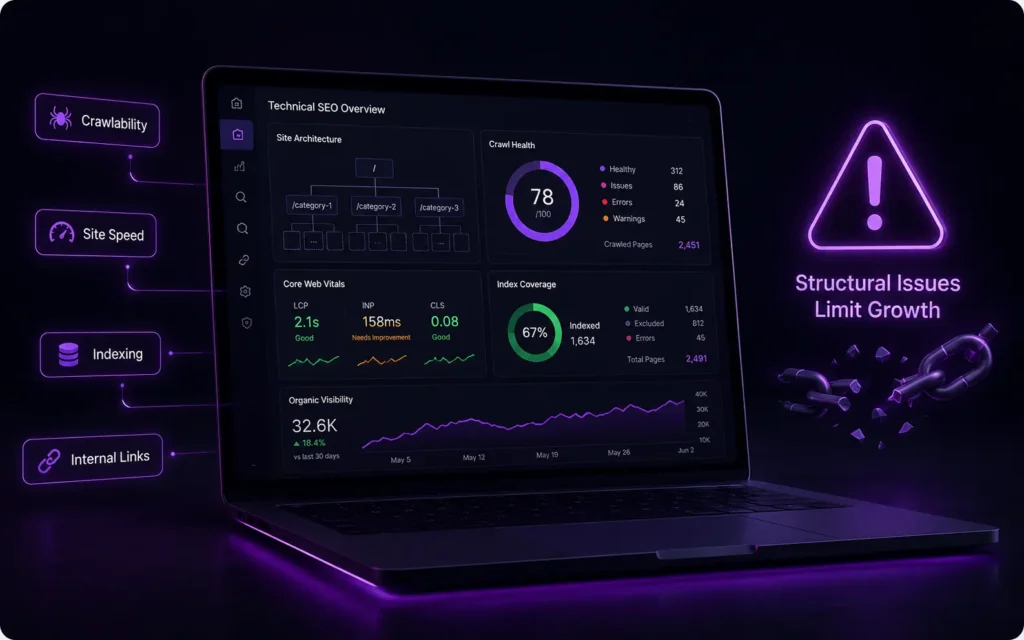
Most businesses reach the same conclusion when their SEO isn’t working: they need more content; technical SEO audit.
More blog posts. More service pages. More FAQs. More keywords.
Sometimes that’s the right call. But often, it isn’t. And when a business invests in content before fixing a structural website problem, the content underperforms — and the real issue stays hidden.
This is one of the most common and expensive patterns I see when I audit websites.
The Assumption That Leads Businesses in the Wrong Direction
The logic is straightforward: more content means more chances to rank, more chances to be found, more chances to win customers. That holds when the website’s foundation is sound.
But if Google is struggling to properly reach your pages, if your website is slow, if key pages are competing against each other, or if your site structure is unclear — publishing more content doesn’t fix any of that. It adds layers on top of an unresolved problem.
Think of it this way: if the roads leading to your location are blocked, building a bigger storefront doesn’t bring more customers. The access problem has to come first.
What “Technical SEO” Actually Means for Your Business
The phrase sounds like something only engineers care about. It isn’t.
Technical SEO is about whether Google can properly find, access, understand, and trust your website. When those conditions aren’t met, your pages — however well-written — may not reach the customers who are already searching for what you offer.
A few examples of what this looks like in practice:
- Your most important service pages exist, but Google isn’t ranking them. The content is solid. The problem may be that those pages are difficult for Google to access, or that the website’s structure doesn’t clearly signal their importance.
- Your website loads slowly. Visitors arrive and leave before reading anything. Your content never gets the chance to work.
- After a website redesign, your traffic dropped. That’s almost always structural — redirects that weren’t set up correctly, URLs that changed without a plan, or authority that didn’t carry over.
- Google is showing an old or incorrect version of your site in search results. That means Google’s understanding of your website has a problem that publishing new pages won’t resolve.
None of these problems respond to more blog posts.
Signals Your Website Has a Structural Problem First
These are situations that point to the technical foundation before content:
Your important pages aren’t ranking despite being well-written
If the content is genuinely relevant and thorough, but the pages stay buried, the problem is often how the website signals importance to Google — how pages link to each other, how the site is organized, which pages are being prioritized.
You had a website migration, redesign, or URL change and traffic dropped
This is almost always a technical issue. Moving a website without careful planning causes organic traffic to fall — sometimes permanently if it isn’t corrected quickly.
Your website is slow on mobile
Speed directly affects whether Google ranks your pages and whether visitors stay long enough to convert. A slow website loses customers before they read a single line.
Google is indexing pages you don’t want indexed, or ignoring pages you do
If low-value pages are consuming Google’s attention while your revenue pages stay under-discovered, no amount of content will correct that imbalance.
You have duplicate pages — multiple versions of the same content
This confuses Google about which page to rank, dilutes whatever authority exists, and can suppress all versions rather than lifting the strongest one.
Signals Your Website Has a Content Problem First
Once the technical foundation is confirmed to be healthy, content becomes the primary lever. These situations suggest content is the real gap:
You’re ranking for the wrong searches
Visitors arrive but don’t convert. The traffic exists, but it comes from people who aren’t looking for what you sell. That’s a content alignment problem — the website is using the wrong language for its actual customers.
Your service or product pages are thin
Generic paragraphs, vague descriptions, no clear answer to what the customer needs to know before making a decision. Google has less reason to rank them, and visitors have less reason to trust them.
You have no content that addresses commercial intent
Customers who are close to making a decision search differently from those who are just researching. If your website only covers broad awareness topics, you’re reaching people who aren’t ready to act — and missing those who are.
Competitors are ranking for searches that should belong to you
If a competitor’s page is clearly more specific, more thorough, or better organized than yours, the content gap is the issue — not the structure.
When You Need Both — And Why Sequence Matters
Most websites that haven’t been actively maintained need both technical work and content improvement. The question isn’t which one matters more. It’s which one needs to come first.
Starting with content when the website has structural problems means the content won’t perform. You’ll invest in something that can’t deliver results yet.
Starting with technical fixes when the real problem is thin, misaligned content means the improvements will hit a ceiling quickly. The structure is clean, but there’s nothing strong enough to rank or convert.
The right sequence comes from diagnosis. What is actually limiting the website right now? That answer determines where to start — and where the budget should go.
How to Recognize Which Problem Your Website Has
You don’t need to run a technical audit yourself to spot the warning signs. If any of these describe your situation, your website may need a proper diagnosis before any further investment:
- Traffic exists but leads are flat or consistently poor quality
- Rankings exist but revenue hasn’t moved with them
- A redesign was followed by a traffic decline that hasn’t recovered
- Important pages exist but aren’t being found by the right searches
- Your competitors appear more frequently across Google despite similar or weaker content
- SEO reports show positive numbers, but those numbers don’t connect to anything that matters for the business
These aren’t content problems. They’re structural and diagnostic problems. The answer isn’t more work — it’s the right work, in the right order.
Before the Next Investment, Find Out What Your Website Actually Needs
If you’re not sure whether your website has a structural problem or a content problem, that’s worth finding out before spending more.
I offer a focused SEO audit that identifies where the real limitation is — structural, content-related, or both — and what to address first based on your business goals.